Birthstones by Month: Colors, Meanings, and How to Wear Each One
By
Tiffany Moore , Thursday, July 16, 2026
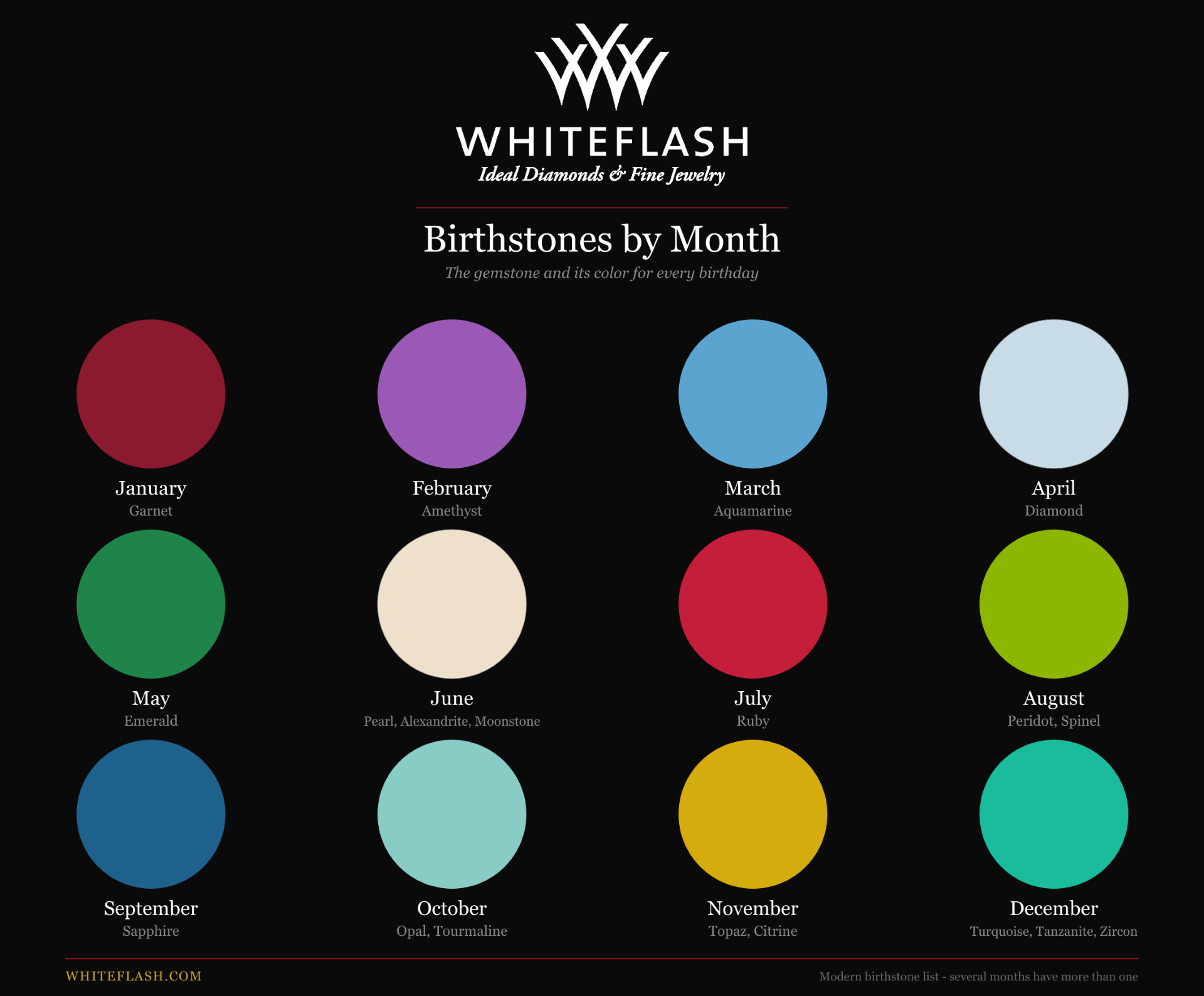
Birthstones by month run from garnet in January and amethyst in February through aquamarine, diamond, emerald, the pearl-alexandrite-moonstone trio of June, ruby, peridot, sapphire, opal and tourmaline, topaz and citrine, and the turquoise-tanzanite-zircon group that closes out December. That single line answers the most common search, but it leaves out the part a jeweler actually cares about: each of these stones has a distinct color, a symbolic meaning, and a hardness that decides where it belongs on the body.
A round brilliant diamond, April’s birthstone set in a 6-Prong Solitaire Engagement Ring
This guide gives you all three. You get a scannable chart of every month's stone, color, and meaning right up top, then a section for each month with its hardness and a practical note on how to wear it. Several months have more than one accepted stone, and the assignments vary slightly between the modern list maintained by Jewelers of America and the older traditional list, so where a month has alternates, we list them all rather than crowning one.
April is the month a fine diamond house knows best, so that section goes deeper. If your birthday falls in April, your stone is the diamond, and it happens to be the one gem on this list built for a lifetime of daily wear.
Birthstone Chart: All 12 Months at a Glance
|
Month
|
Birthstone(s)
|
Color
|
Meaning
|
|
January
|
Garnet
|
Deep red (also green, orange, purple, yellow)
|
Protection, loyalty, friendship
|
|
February
|
Amethyst
|
Purple, lilac to deep reddish-purple
|
Peace, clarity, sobriety
|
|
March
|
Aquamarine
|
Light blue to blue-green
|
Calm, courage, safe travel
|
|
April
|
Diamond
|
Classically colorless; fancy colors exist
|
Strength, clarity, enduring love
|
|
May
|
Emerald
|
Vivid green
|
Rebirth, love, foresight
|
|
June
|
Pearl, Alexandrite, Moonstone
|
White and cream; color-change green/red; blue sheen
|
Purity, good fortune, intuition
|
|
July
|
Ruby
|
Red to purplish-red
|
Passion, protection, vitality
|
|
August
|
Peridot, Spinel (Sardonyx traditional)
|
Yellow-green; red and other colors; red
|
Strength, healing, good fortune
|
|
September
|
Sapphire
|
Velvety blue (also pink, yellow, and other fancy hues)
|
Wisdom, loyalty, faithfulness
|
|
October
|
Opal, Tourmaline
|
Play-of-color flashes; widest color range of any gem
|
Hope, creativity, inspiration
|
|
November
|
Topaz, Citrine
|
Golden and blue; yellow to orange
|
Warmth, good fortune, positivity
|
|
December
|
Turquoise, Tanzanite, Zircon
|
Robin's-egg blue-green; violet-blue; light blue
|
Protection, calm, success
|
Birthstone assignments vary slightly between the modern (Jewelers of America) and traditional lists, and several months have more than one accepted stone. The list below follows the widely cited modern assignments, with traditional alternatives noted where they matter.
January: Garnet
Garnet is best known as a deep, glowing red, but the garnet family also occurs in green, orange, purple, and yellow, so January babies have more range than the red tradition suggests. The stone has long symbolized protection, loyalty, and friendship, and was once carried by travelers as a safeguard.
14k White Gold Semi Custom Seven Stone Shared-Prong Diamond and tsavorite garnets Wedding Ring
At a Mohs hardness of 6.5 to 7.5, garnet is durable enough for regular wear but soft enough to scratch over years of hard contact. It suits rings worn occasionally and is very comfortable in pendants and earrings, where it stays clear of daily knocks. Our
January birthstone guide breaks down the full range of garnet colors and how to care for each.
February: Amethyst
February's amethyst is the purple variety of quartz, ranging from a pale lilac to a deep, saturated reddish-purple. It has carried associations with peace, mental clarity, and sobriety since antiquity, when it was believed to keep the wearer level-headed.
Silver Tacori SE15501 Lilac Blossoms Amethyst Earrings
Amethyst sits at 7 on the Mohs scale, so it holds up reasonably well in everyday jewelry, though prolonged sun exposure might fade its color over time. It is a strong choice for cocktail rings, pendants, and earrings, and benefits from being stored away from harder gems that could scratch it. There is more on its color grades and long history in our
February birthstone guide.
March: Aquamarine
Aquamarine is a member of the beryl family, the same family as emerald. It shows a light blue to blue-green color that always stays gentle in saturation. Its name comes from seawater, and it has traditionally symbolized calm, courage, and safe passage for travelers and sailors. Bloodstone is the older traditional stone for March, and our
March birthstone guide covers both.
14k Yellow Gold Oval Halo Aquamarine and Diamond Right Hand Ring
At 7.5 to 8 on the Mohs scale, aquamarine is harder than quartz and well suited to rings as well as pendants and earrings. It is one of the more wearable colored stones for everyday jewelry.
April: Diamond, and Why It Is the Daily-Wear Champion
April is the diamond's month, and it is the one birthstone built to be worn every single day without compromise. A diamond is classically colorless, graded on the GIA scale from D through Z, though fancy colored diamonds exist across the spectrum. Its meaning is fitting for the hardest natural material on earth: strength, clarity, and enduring love.
Platinum Valoria French-Set Diamond Engagement Ring
That hardness is not a marketing flourish. Diamond is a 10 on the Mohs scale, its maximum, and many times harder in practical terms than anything below it. This is why diamond is the default for engagement rings and other pieces that face daily wear and tear. Where a softer birthstone needs a protective setting, a diamond can take some hard knocks, and decades of wear, and still look the way it did on day one.
What Makes a Diamond Perform
Two diamonds with the same grades on paper can look very different in person, because cut quality, not carat weight, decides how a diamond returns light. A precisely cut diamond gathers light and sends it back to the eye as brightness, fire, and scintillation. A poorly proportioned one leaks light through the bottom and can look lifeless even at a high color and clarity grade. If you are new to how the four characteristics interact, the
Diamond Education Center walks through carat, cut, color, and clarity in order of how much each one actually affects appearance and price.
Because April's stone is defined partly by its color, the
diamond color chart and buying guide is worth reading before you shop. It explains where the eye can and cannot detect color, and how the metal of a setting changes how white a diamond looks on the finger.
The A CUT ABOVE® Standard
A CUT ABOVE® is the Whiteflash super ideal natural diamond brand, and it represents the strictest level of cut quality. Each one begins as a GIA Triple Excellent diamond, earns an AGS Ideal addendum issued by GIA, and is further analyzed with ASET, Ideal-Scope, and Hearts & Arrows imaging before a final visual review and approval. Fewer than one in ten AGS Ideal diamonds meet
all requirements for A CUT ABOVE® status, and each qualifies for the Whiteflash Lifetime Upgrade Program, under which the full value applies as credit toward any other natural A CUT ABOVE® diamond of at least 50% greater value, at any time.
NATURAL DIAMONDS
0.71 H VS1 Round Ideal
A CUT ABOVE®
$2,275
|
|
| Light Perf. |
|
| Polish |
|
| Symmetry |
|
| Depth % |
|
| Table % |
|
| Crown Angle |
|
| Star |
|
| Pavilion Angle |
|
| Crown % |
|
| Lower Girdle |
|
| Measurements |
|
| L/W Ratio |
|
| Fluorescence |
|
| Eye Clean |
|
|
View Details
|
|
0.71 H VS1 Round Ideal
A CUT ABOVE®
$2,275
|
|
| Light Perf. |
|
| Polish |
|
| Symmetry |
|
| Depth % |
|
| Table % |
|
| Crown Angle |
|
| Star |
|
| Pavilion Angle |
|
| Crown % |
|
| Lower Girdle |
|
| Measurements |
|
| L/W Ratio |
|
| Fluorescence |
|
| Eye Clean |
|
|
View Details
|
|
1.02 I SI1 Round Ideal
A CUT ABOVE®
$3,995
|
|
| Light Perf. |
|
| Polish |
|
| Symmetry |
|
| Depth % |
|
| Table % |
|
| Crown Angle |
|
| Star |
|
| Pavilion Angle |
|
| Crown % |
|
| Lower Girdle |
|
| Measurements |
|
| L/W Ratio |
|
| Fluorescence |
|
| Eye Clean |
|
|
View Details
|
|
0.82 F SI1 Round Ideal
A CUT ABOVE®
$2,850
|
|
| Light Perf. |
|
| Polish |
|
| Symmetry |
|
| Depth % |
|
| Table % |
|
| Crown Angle |
|
| Star |
|
| Pavilion Angle |
|
| Crown % |
|
| Lower Girdle |
|
| Measurements |
|
| L/W Ratio |
|
| Fluorescence |
|
| Eye Clean |
|
|
View Details
|
|
For an April birthday, that combination means the gift performs and holds its standing for the long term. Our
April birthstone guide goes further into the diamond's long history as a birthstone.
May: Emerald
Emerald is the vivid green member of the beryl family, sometimes leaning bluish-green, and few colors in fine jewelry are as instantly recognizable. It has symbolized rebirth, love, and foresight across many cultures.
Color and clarity drive emerald value more than they do for almost any other gem. Our
May birthstone guide explains what to look for. On hardness, emerald reads 7.5 to 8, but the number is misleading: most emeralds contain internal inclusions that make them more brittle than aquamarine, so they need gentler handling than their Mohs rating suggests. That makes emerald beautiful in a ring with a protective setting and an excellent, lower-risk choice in pendants and earrings.
14k White Gold Semi Custom Flower Cluster Diamond Pendant with Aquamarine and Emerald Center Stones
June: Pearl, Alexandrite, and Moonstone
June has three accepted birthstones, each with a different personality. Pearl is the classic, in white, cream, or black, prized for purity and wisdom. Alexandrite is the rare color-change gem, green in daylight and red or purple under incandescent light, associated with good fortune and balance. Moonstone shows a floating blue or rainbow sheen called adularescence and is tied to intuition.
18k White Gold Gaia Pearl and Diamond Right Hand Ring
Their durability varies widely. Alexandrite is hard at 8.5 and suits rings. Moonstone, at 6 to 6.5, is better in pendants and earrings. Pearl is the softest at 2.5 to 4.5 and should be treated as protected-wear jewelry, kept away from cosmetics and perfume and worn most safely as a necklace or stud. You can read about all three in our
June birthstone guide.
July: Ruby
Ruby is the red variety of corundum, ranging from pure red to a slightly purplish or pinkish red, and the finest stones command some of the highest prices per carat of any colored gem. It has long stood for passion, protection, and prosperity.
Platinum Valoria Oval Two Stone Right Hand Ring
Ruby is a 9 on the Mohs scale, second only to diamond among common gems, which makes it one of the few colored stones genuinely suited to a daily-wear ring. It performs well in every type of setting and is a confident choice for an engagement or anniversary ring, with more on origin and the factors that drive quality in our
July birthstone guide.
August: Peridot and Spinel
August's primary stone is peridot, an olive to yellow-green gem with a distinctive warm tone. Spinel was officially added in 2016 and comes in many colors, with red and blue the most sought after. Sardonyx, with its banded red-brown and white layers, is the older traditional August stone. The group is associated with strength, healing and luck.
14k White Gold Solitaire Genuine Arizona Peridot Pendant
Hardness separates them: spinel is a hard 8 and well suited to rings, while peridot at 6.5 to 7 and sardonyx around the same are better in pendants and earrings, where they avoid abrasion. Our
August birthstone guide lays out how the three compare.
September: Sapphire
Sapphire is corundum's other famous form, most celebrated as a deep, velvety blue, though it also occurs in pink, yellow, and other fancy colors. It has symbolized wisdom, loyalty, and faithfulness for centuries and remains a popular center stone for engagement rings.
Like ruby, sapphire is a 9 on the Mohs scale, which puts it firmly in daily-wear territory. It is one of the most practical colored stones for a ring you never take off. Our dedicated
guide to sapphires goes deep on color and origin, and the
September birthstone guide rounds up the month's options.
Platinum Alternating Blue Sapphire and Diamond Tennis Bracelet
October: Opal and Tourmaline
October offers two very different stones. Opal is famous for its play-of-color, flashes of spectral hues that drift across a white, gray or black body, and it symbolizes hope, creativity, and inspiration. Tourmaline has the widest color range of any gem and is associated with balance and protection.
Their care needs differ. Tourmaline, at 7 to 7.5, handles rings reasonably well. Opal is soft and porous at 5 to 6.5, sensitive to knocks and to changes in temperature and humidity, so it belongs in protected settings, pendants, and earrings rather than an everyday ring. Our
October birthstone guide covers handling and selection for both stones.
14k Yellow Gold 3 Prong Triangle Tourmaline Earrings
November: Topaz and Citrine
November pairs topaz and citrine, two warm-toned stones. Topaz is traditionally golden or orange but also occurs in blue, colorless, and pink. Citrine is the yellow-to-orange variety of quartz. Together they carry meanings of warmth, good fortune, and positivity.
Silver Tacori SR12302 Island Rains Sky Blue Topaz Ring
Topaz, at 8 on the Mohs scale, is durable enough for rings, though it can chip on a hard blow because of its cleavage, so a protective setting helps. Citrine sits at 7 and works well across rings, pendants, and earrings. Our
November birthstone guide explains the color grades to look for in each.
December: Turquoise, Tanzanite, and Zircon
December has three modern options rather than one. Turquoise shows its signature robin's-egg blue-green. Tanzanite, added to the list in 2002, is a violet-blue gem found in only one place on earth. Zircon, most prized in blue, also occurs colorless and brown. The group is associated with protection, calm, and success. Depending on the list, lapis lazuli and blue topaz also appear as December stones.
Platinum "Champagne" Diamond and Tanzanite Right Hand Ring
All three lean toward the softer end. Turquoise at 5 to 6, tanzanite at 6 to 7, and zircon at 6 to 7.5 are best protected in pendants and earrings, with tanzanite in particular benefiting from a setting that shields it from impact. Our
December birthstone guide details each of the three.
How to Wear Each Birthstone: Matching Stone to Setting
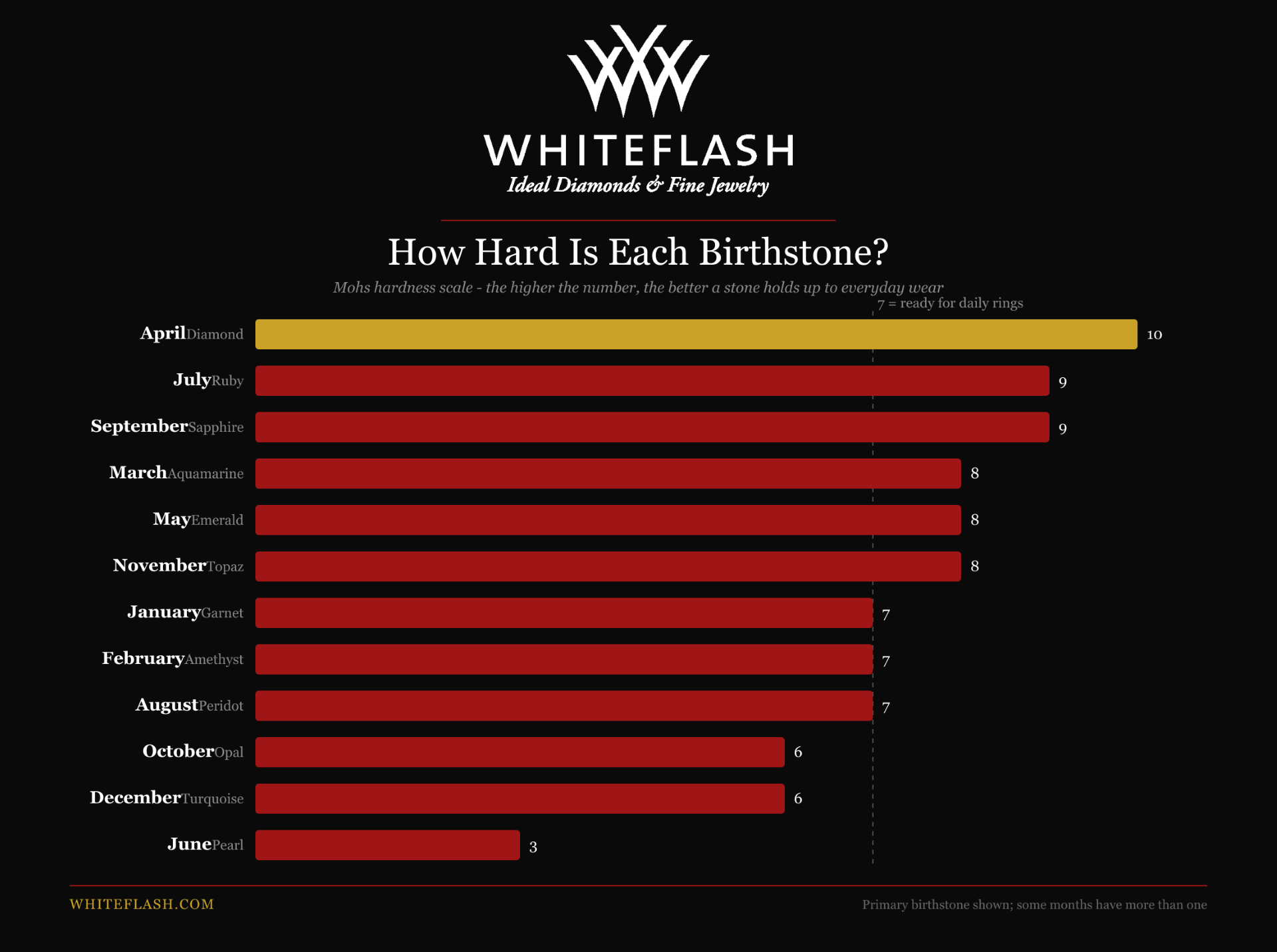
The single most useful thing a jeweler can add to a birthstone list is which stones survive daily wear and which need protection. Hardness, measured on the Mohs scale, is the deciding factor, and it sorts the twelve months into clear groups.
Hard Stones for Rings and Daily Wear
Diamond at 10, plus sapphire and ruby at 9, sit at the top and are the natural choices for engagement rings and any ring worn every day. Spinel, topaz, and alexandrite at 8 to 8.5 also handle ring wear well. Aquamarine at 7.5 to 8 is a strong everyday option. These stones tolerate the constant contact a ring takes against desks, doors, and countertops.
Medium Stones for Thoughtful Ring Use
Amethyst, citrine, garnet, and tourmaline land around 7. They work in rings, but they reward a protective setting and occasional rather than constant hard wear. They are entirely comfortable in pendants and earrings.
Softer Stones for Protected Pendants and Earrings
Opal, turquoise, tanzanite, moonstone, peridot, and pearl fall between roughly 2.5 and 6.5. These are best kept off the daily-wear ring and showcased instead where they are shielded from knocks. A pendant or a pair of earrings keeps a soft stone safe while putting its color at eye level, which is often where it looks best anyway.
Diamond pendants and
diamond earrings make natural settings for both softer birthstones and diamond accents, and the
colored gemstones and pearls category is the place to browse colored-stone pieces for gifting.
Birthstone jewelry makes a personal gift for a birthday, an anniversary, or a milestone, and diamond studs or a pendant work for any month while staying within everyday-wear durability.
Frequently Asked Questions
What is the birthstone for April?
April's birthstone is the diamond. It is classically colorless and is the hardest natural material at a 10 on the Mohs scale, which makes it the standard choice for engagement rings and other pieces worn every day.
What is the birthstone for September?
September's birthstone is the sapphire, most famous in deep blue but also found in pink, yellow, and other fancy colors. At a Mohs hardness of 9, it is one of the most durable colored stones and well suited to daily-wear rings.
Which months have more than one birthstone?
Several months have more than one accepted stone. June has pearl, alexandrite, and moonstone; August has peridot and spinel, with sardonyx as the traditional option; October has opal and tourmaline; November has topaz and citrine; and December has turquoise, tanzanite, and zircon. Assignments vary slightly between the modern Jewelers of America list and the older traditional list.
Can I wear a birthstone that isn't my birth month?
Yes. Birthstones are a tradition, not a rule, and many people choose a stone for its color, meaning, or durability rather than their birth month. A stone tied to a partner's or child's month is also a common choice for a personalized gift.
Which birthstones are best for everyday rings?
Diamond, sapphire, and ruby are the most durable and the best suited to rings worn every day, followed by spinel, topaz, alexandrite, and aquamarine. Softer stones such as opal, pearl, turquoise, and tanzanite are better worn in pendants and earrings that protect them from impact.
Which birthstone is the hardest?
Diamond is the hardest birthstone and the hardest natural material, topping the Mohs scale at 10. Ruby and sapphire follow at 9.